Substantively reviewed August 14, 2026 · Editorial policy · Request a correction
Strategy has to start with an exact ruleset
Quick answer: In Klondike, prefer moves that expose a face-down tableau card, create usable space, or improve access to the stock. A legal move is not automatically a useful move, and no move-order checklist can guarantee that every deal will be won.
The baseline rules in this article follow the tableau, stock, waste, foundation, and King-to-empty-space definitions in Bicycle Cards’ Solitaire rules. Before comparing advice or win rates, state whether the game is Draw 1 or Draw 3, whether redeals are limited, and whether foundation cards can return to the tableau. Those choices can change which cards are reachable.
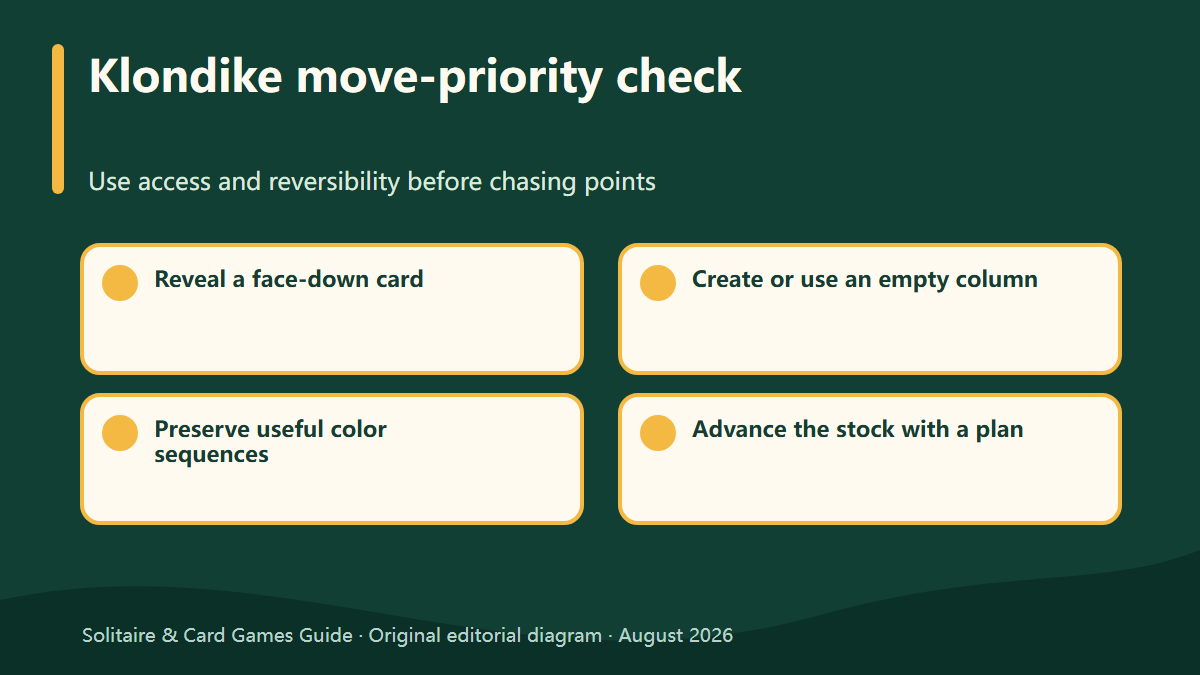
Use the diagram below as a decision order, not as a scoring promise. For the arithmetic behind Standard, Vegas, and timed systems, continue to the separate Solitaire scoring guide.
Introduction
Once you’ve mastered the basics of Solitaire, the real fun begins. It’s no longer about simply finishing a game—it’s about how efficiently you can do it, how quickly you can react, and how high of a score you can rack up in the process. For many players, the thrill lies in shaving seconds off their time or pulling off clever moves that lead to a satisfying victory. If you’re ready to take your Solitaire skills to the next level, this guide will introduce advanced strategies that can help you maximize your score while keeping the game engaging.
Understanding How Solitaire Scoring Works
To get better at scoring, it helps to know what contributes to your points in the first place. In most Solitaire variations, you earn points for moving cards to the foundation and for creating sequences in the tableau. Some versions also reward speed, so quick and accurate moves matter.
This means your strategy isn’t just about completing the game—it’s about doing so with intention. Every move counts, and even a small hesitation or unnecessary shuffle can lower your potential score.
Strategy 1: Reveal Hidden Cards Whenever Possible
Revealing hidden cards is the golden rule of advanced Solitaire. The more cards you turn over, the more opportunities you unlock. If you’re faced with two possible moves, always prioritize the one that uncovers a hidden card.
Players often share stories of hitting their highest scores when they shifted their focus from “just moving cards” to “unlocking new options.” For example, one player mentioned how a single move that revealed a long-hidden King turned the entire game around, opening multiple sequences and leading to a record score.
Strategy 2: Build Foundations Strategically, Not Automatically
Yes, moving Aces and low cards to the foundation feels good—but resist the urge to do it immediately every time. Advanced players know that sometimes it’s smarter to keep cards in the tableau for flexibility.
Imagine you have a black 5 in the foundation but need it in the tableau to move a red 6 and uncover hidden cards. By holding back certain cards temporarily, you create more options for sequences and uncover faster routes to victory. This kind of delayed gratification often separates high scorers from casual players.
Strategy 3: Alternate Colors for Maximum Mobility
One of the keys to keeping your game fluid is ensuring that your tableau stacks alternate colors in ways that maximize mobility. For instance, if you’re moving a red 7, consider whether placing it on a black 8 will allow for more flexible moves later.
This approach isn’t about short-term wins—it’s about building a system where multiple cards remain playable. Experienced players often describe this as “keeping the game breathing.” When you can consistently move cards without hitting a dead end, your score naturally rises.
Strategy 4: Master the Stock Pile
The stock pile can be your best friend or your worst enemy. Beginners tend to flip through it quickly, but advanced players use it carefully. Pay attention to the order of cards that come up—sometimes it’s better to hold off flipping a card until you know it will lead to a productive move.
Think of the stock pile as your hidden reserve. Knowing when to access it and when to save it gives you an edge, especially in timed versions of Solitaire where every second matters.
Strategy 5: Optimize for Speed Without Rushing
Scoring systems often reward speed, but rushing can create sloppy mistakes. The trick is to play smoothly, with a rhythm that balances accuracy and quick decision-making.
Some players treat Solitaire like a reflex game, training themselves to recognize common patterns instantly. One memorable example came from a user who bragged about scoring 420 points in just four minutes—not because they moved randomly, but because they trained themselves to react efficiently under time pressure.
Practicing with Google Solitaire
For practicing these strategies, Google Solitaire is one of the easiest platforms to use. Since it runs directly in your browser, you can play multiple games back-to-back without interruption. This makes it perfect for testing out advanced strategies and refining your speed.
Players often describe how seamless the experience feels: quick loading, clean visuals, and straightforward gameplay that keeps the focus on strategy rather than distractions. Many beginners turn into high scorers simply by setting daily practice sessions on Google Solitaire, gradually noticing improvements in both speed and decision-making.
Avoiding Overconfidence
Advanced strategies are powerful, but they can backfire if you get overconfident. Some players move too aggressively, rushing cards into the foundation or making risky moves without considering the bigger picture. The best approach is balance—combining bold decisions with patience.
Solitaire, after all, is as much about discipline as it is about clever tricks. Every game teaches a new lesson, and every high score comes from a mix of skill, strategy, and restraint.
Related solitaire guides
- How to Play Klondike Solitaire: Rules and a Worked Example — Check the exact Klondike rules assumed by many strategic examples.
- The Science of Winning: How Probability Shapes Your Moves — Use the probability guide to separate visible options from uncertain outcomes.
Related reading
Conclusion
Reaching higher scores in Solitaire isn’t just luck—it’s about applying smart strategies consistently. Focus on revealing hidden cards, building foundations strategically, alternating colors for flexibility, mastering the stock pile, and playing with smooth efficiency. By incorporating these techniques, you’ll not only win more often but also rack up scores that reflect your growing mastery.
Platforms like Google Solitaire make practicing these skills easier than ever. Whether you’re aiming to beat your personal record or simply enjoy the satisfaction of cleaner, smarter gameplay, these strategies will push your Solitaire experience to the next level.
So, are you ready to challenge yourself? The next time you deal a game, try holding back that tempting move, look a few steps ahead, and see how your score climbs.
Related practical guides: Solitaire scoring formulas and examples, Draw 1 versus Draw 3.